
Betting from the capital
Delhi is a cricket city with an unusually strong kabaddi following and a football audience that watches Europe rather than India. It is also the only Indian metro where the question "what are the rules here" has three answers depending on which side of a flyover you sleep.
The Kotla plays slower than it looks
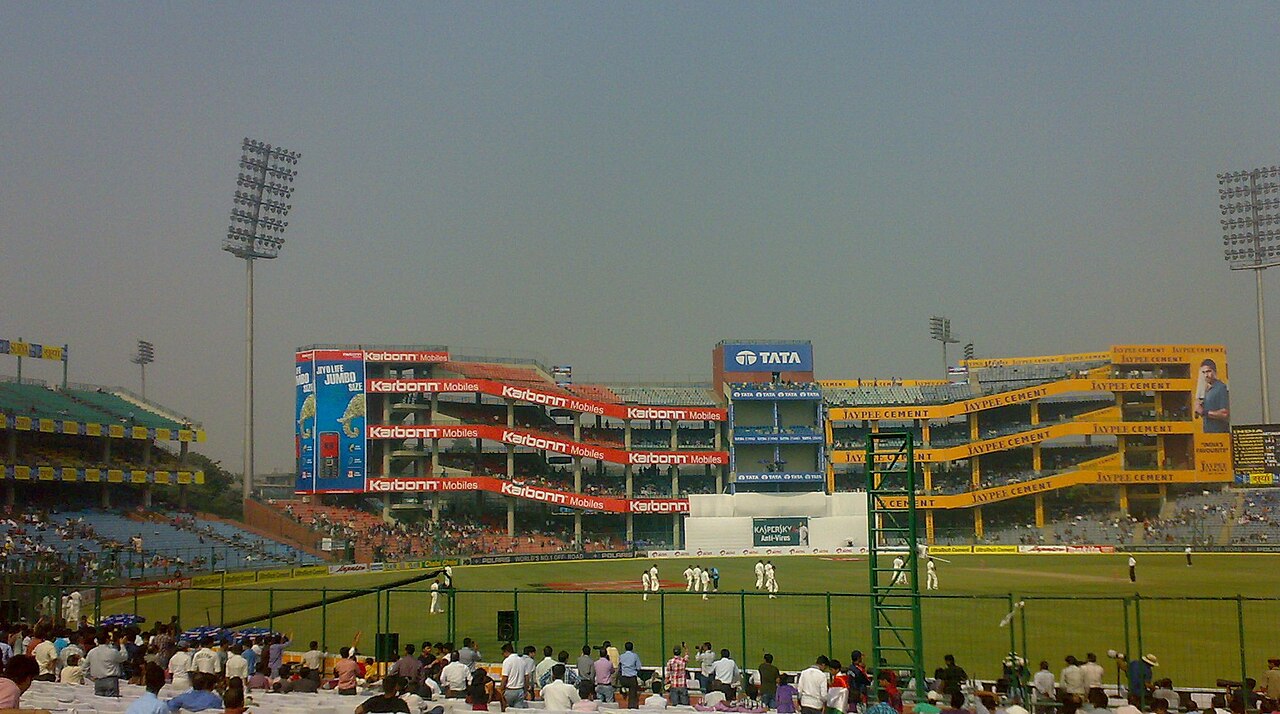
Grounds get reputations that outlive their surfaces, and the Arun Jaitley Stadium has one for being a batting venue. In practice it grips, it takes some turn, and it slows through the middle overs. Par sits below what a bettor coming from Bengaluru would assume.
The practical consequence is in the session markets. A middle-overs line priced off IPL averages is frequently a touch high at the Kotla, and spinners appear in top bowler markets more often than the venue's reputation implies. Waiting until the powerplay has finished before taking a totals position is worth more here than at a genuinely flat ground.
Fog is a real betting variable in December
No other major Indian sporting city has this problem. Delhi winters bring dense fog and poor air quality, and both have interrupted professional cricket in the city before — there is precedent for players taking the field in masks.
For most bettors this only matters on domestic fixtures in deep winter, when a shortened or abandoned match changes how markets settle. But it is worth knowing that a Delhi fixture in late December carries a weather risk that a Chennai fixture simply does not, and that the settlement rule printed on each market is the thing to read before staking.

Kabaddi has roots here, not just viewers
Pro Kabaddi is often described as a television creation, and in some cities that is fair. Around Delhi it is not. Haryana in particular has produced a large share of the league's professional players, and the sport has been played in the villages of the region for generations.
That depth of following matters for betting, because kabaddi markets are thin and priced by relatively few people. Somebody in the NCR who actually watches the league holds an information advantage that is very difficult to find in an IPL market — the kabaddi page sets out the scoring and which markets reward that knowledge.
A football audience pointed at Europe
Unlike Kolkata, Delhi has no deep domestic football culture to speak of. What it has is a large audience for the Premier League and the Champions League, which means a great deal of the city's football betting happens between 11 PM and 3 AM.
That has a practical consequence worth naming: those are hours when bank transfers do not move and tired decisions get made. UPI works identically at 2 AM and 2 PM, which is why it dominates here, and a deposit limit set in daylight is worth considerably more than good intentions at kick-off.
A November night in Karol Bagh, and a raid the group chat got wrong
Deepak is thirty-six. He runs a spare-parts counter off Ajmal Khan Road and lives two floors above it. On a Saturday in the middle of November he pulls the shutter down a little after half past eight, eats standing in the kitchen because his father is already asleep in the next room, and puts the kabaddi on with the sound almost off. His phone lies flat beside the plate. Six men are arguing in a WhatsApp group he has been in for years — the same lot he played with on a patch of ground behind Model Town before any of them had jobs, shops or knees that complain.
He has ₹300 on Dabang Delhi, placed before the whistle at whatever the opening price happened to be. It is not a large amount. It is roughly what the six of them have been staking on each other's opinions since long before any of this moved onto a phone.
With a few minutes left the defending side is down to three men on the mat and the group turns loud. Two of them have already written it off. Deepak has not, and his reasoning owes nothing to a model: a side reduced that far earns two points for a tackle rather than one, which is enough to turn a losing scoreline into a level one inside a single raid. He picks the phone up off the table.
What actually happens when you tap a price mid-match
The first thing he sees is that he cannot bet. The market has gone grey. Prices suspend around a scoring event, because for a second or two the screen in Karol Bagh and the mat are not describing the same match, and nothing is accepted while that gap is open. It clears in a few seconds and the number comes back — shorter than it was, because the whole book has watched the same thing he has.
He taps it and the slip does the second useful thing: it shows him the price it is about to take, not the price he tapped. If those differ he has to confirm the new one. Say the slip settles at 1.75. He types ₹300, the slip works out a ₹525 return, and it prints that figure before he commits rather than after. Confirming does two visible things at once. The wallet balance drops by ₹300 immediately, and the bet appears in his bet history with a timestamp and the exact price it was matched at.
That last line is the one worth internalising. The number in the history is the number that settles the bet — not the one on the screen when he first reached for the phone, and not the one the group chat was shouting about. Settlement runs after the final whistle and the return lands in the same wallet it came out of. Deepak was right that night. He has been wrong plenty of other nights, on the same ₹300, which is rather the point of keeping the stake at ₹300.
The one that catches people between Rajiv Chowk and home
A lot of Delhi betting is done standing up, holding a rail. The metro is where the NCR does its reading, and it is also where the signal disappears — between stations, in the crush at an interchange, in the lift out of a deep platform. The failure people run into is always the same shape. A tap goes in, the screen hangs, nothing confirms, and the natural response is to tap again.
The tap either reached the server or it did not, and only one place on the phone knows which. Open bets, not the market screen. If the bet is listed there it went through and a second tap creates a second bet at whatever price is live by then; if it is not listed, nothing was taken and the wallet will show it. The habit worth building is to check the history before re-placing anything, and to take positions before you go underground rather than during the four minutes you are out of coverage. The FairPlay app holds the same bet history as the site, so a bet placed on a laptop at home is visible on the phone on the way to work.
Three postcodes, one group chat
Two of those six men live in Indirapuram, one in Gurugram, and the rest inside Delhi proper. For the NCR that is completely ordinary, and it is also why the table further up this page exists. Gambling is a state subject in India, so Delhi, Haryana and Uttar Pradesh each set their own position, and six friends in one chat are not necessarily under one set of rules. Read the position that applies where you actually live rather than where you work, and treat a friend's confidence as a statement about his own address and nothing more.
Money at hours when the banks are asleep
The Champions League nights are the ones that expose how a wallet behaves. A game kicking off past midnight means deposits and withdrawals get thought about at an hour when nobody in a branch is awake, and the payment methods that matter in Delhi are the ones that do not care what time it is. UPI settles at one in the morning the way it settles at one in the afternoon.
Withdrawals are the half people leave until they are impatient. Money returns to the bank account your verification was matched against, and the name on that account has to agree with the name on the profile — a nickname on one side and a full legal name on the other is the commonest reason a payout sits still. The withdrawal page sets out what gets compared. Sorting it on a quiet Sunday afternoon costs nothing; discovering it at half past one with a match finishing is a genuinely miserable way to spend a night.
The call that says it is your Delhi account manager
Popular platforms get impersonated, and the version working the NCR at the moment is a phone call rather than a message. The caller speaks unhurried Hindi, knows the city well enough to place you, and says he looks after accounts for the Delhi region. He opens with something plausible — a withdrawal that has not moved, a verification step that has to be finished tonight. Then comes the actual request: install a small app so he can see your screen and fix it from his end, or simply read out the code that has just arrived by SMS.
The tell is not his accent and it is not his story, both of which are good. Nobody from FairPlay asks for an OTP or a password, on a call or in a chat window, for any reason whatsoever, and nobody needs to watch your screen to repair an account. An OTP exists so that only the person holding the handset can complete something. Reading it aloud hands over precisely that. A second version turns up as a payment request inside a UPI app, occasionally with a ground or a team name typed into the note so it looks connected to a match you were watching. A deposit begins on the deposit screen inside your own account. A request that arrives from outside it did not begin there and is not one.
The safe move costs half a minute. End the call, open the account yourself by typing the address in rather than tapping anything anybody sent you, and look at the balance and the wallet history. If something real happened it is already sitting there where you can see it. If it is not there, nothing happened. Anything that looked convincing is worth passing on to customer support, because calls like these are made in volume and yours is very unlikely to be the only number dialled that evening.
The same board, whichever part of the country opens it
One thing a city page can accidentally imply is that there is a Delhi version of the product. There is not. Behind all of this sits a single FairPlay India account structure, and it does not change by pin code. A Dabang Delhi fixture priced at nine on a Saturday reads identically on a phone in Karol Bagh and on a phone in a district town four hours up the highway: the same markets, the same minimum stake, the same settlement rule printed on the event itself, the same Hindi on live chat at the same hour of the night.
What is local here is the sport, not the platform. The Kotla surface, the December fog, the depth of kabaddi in the villages around the capital, the hours European football keeps in Indian time — those are Delhi facts and they are why this page exists. Everything underneath them is national. Somebody who moves from Rohini to a smaller town for work carries the identical account across: the same login, the same wallet, pending bets still pending, and no reinstalling of anything. Metro or mofussil, the board is assembled in one place and served to everybody.
If you have not opened an account yet
None of the above needs much to get started. FairPlay register wants a working mobile number and nothing more elaborate than that. An OTP arrives on it within a few seconds, and the password is set on the same screen while the OTP is still on the display. That is the whole of it, start to finish. There is no separate sign-up for kabaddi and another for cricket and a third for the casino tables — one account covers the lot and everything runs off a single wallet.
Every visit after that goes through the same FairPlay login screen: the number you registered with, and the password you picked. Do it on a slow afternoon rather than at ten past nine with a raid already going on, because the first deposit and the identity check attached to it take a few minutes and are far less irritating when nothing is riding on them. Once the account is open you can read markets without staking anything at all, and that is the sensible way to spend a first evening — working out what a session line or a raid market is genuinely asking before ₹300 depends on the answer.